
THE DEEP DIVE
The Necrophilic Cult of the Vanni: How the LTTE Cannibalized the Tamil Struggle, and the Grotesque Farce of Modern Dravidian Politics

            THE MORAL AMNESIA INDEX
[The PR Myth]         [The Savage Reality]
A "Freedom Army"  --> An ethno-fascist junta that executed its own intellectuals.
Tamil Pride       --> Murdered thousands of innocent Tamils who dared to disagree.
Chivalrous Icons  --> Used pregnant women and brainwashed children as human bombs.
History is a highly profitable industry for opportunistic politicians, but some chapters are so profoundly rotten that any attempt to sanitize them borders on a moral crime.
For decades, the tragedy of the Sri Lankan Civil War has been systematically hijacked by a dangerous, romanticized amnesia. What began as a legitimate socio-political struggle for Tamil dignity in the face of Colombo’s majoritarian discrimination was rapidly captured, weaponized, and ultimately destroyed by the Liberation Tigers of Tamil Eelam (LTTE).
Under the absolute, messianic command of Velupillai Prabhakaran, the LTTE did not liberate the Tamil people. Instead, they institutionalized a death cult. They cannibalized the Tamil center, pioneered the assembly-line use of child soldiers, and transformed the Northern Province of Sri Lanka into a totalitarian open-air prison.
To look closely at the LTTE today is to conduct an autopsy on a fascist failure. Yet, looking across the political landscape of Tamil Nadu, the ghost of this ethno-fascist enterprise is being actively revived as a cynical, high-fashion political accessory. From mainstream film stars turned Chief Ministers seeking to weaponize ultra-nationalist sentiments, to an executive branch rolling out red carpets for convicted assassins, to a judiciary completely detached from moral baseline reality, the ongoing rehabilitation of the LTTE’s legacy is a strategic and civilizational catastrophe.
1. The “Sole Representative” Lie: A Monopoly Built on Tamil Blood
The foundational crime of the LTTE against the Tamil people was its absolute declaration that it was the “sole representative” of the community. This wasn’t a mandate earned through democratic consensus or an electoral ballot; it was a dictatorial fiat written in the blood of rival Tamil militants and moderate intellectuals.
As thoroughly documented across historical reviews on Amaruvi’s Aphorisms, the LTTE spent the 1980s and early 1990s engaged in savage, internecine purges. They didn’t just target the Sri Lankan state; they systematically liquidated any Tamil who offered an alternative path to peace. Groups like the Tamil Eelam Liberation Organization (TELO), the People’s Liberation Organisation of Tamil Eelam (PLOTE), and the Eelam People’s Revolutionary Liberation Front (EPRLF) were not merely outvoted; their cadres were hunted down, lined up, and executed in cold blood to guarantee that no secondary power center could exist.
               [THE TOTALITARIAN PURGE OF THE TAMIL INTELLIGENTSIA]
                                        │
         ┌──────────────────────────────┼──────────────────────────────┐
         ▼                              ▼                              ▼
[Dr. Neelan Thiruchelvam]     [Lakshman Kadirgamar]          [Rajani Thiranagama]
 - Harvard Constitutional      - Foreign Minister             - Human Rights Academic
   Lawyer & Devolution           who exposed the LTTE's         and co-author of 'The
   Architect.                    global extortion rings.        Broken Palmyra'.
         │                              │                              │
         ▼                              ▼                              ▼
[Blown up by a suicide       [Shot dead by a sniper         [Executed on her bicycle
 bomber in Colombo, 1999]     in his pool, 2005]             while riding home, 1989]
By methodically killing the moderates, Prabhakaran ensured that the only path forward was his path: a path of perpetual war and absolute obedience. As noted in my site www.amaruvi.in, the “maniacal impulses” of the Vanni leadership were routinely masked by the sophisticated, Western-facing rhetoric of Anton Balasingham. Balasingham functioned as the civilized mask hiding a grotesque face, dressing up raw, fascist bloodlust in the international vocabulary of national liberation.
The list of high-profile victims who fell to the Tiger’s paranoia reads like a directory of the finest South Asian minds and leaders:
Alfred Duraiappah (1975): The Mayor of Jaffna, a moderate Tamil politician gunned down by Prabhakaran himself while entering a temple—the murder that inaugurated the LTTE’s culture of political assassinations.
Sabaratnam (1986): The leader of the rival TELO group, hunted down and shot personally by LTTE commander Sathasivam Krishnakumar (Kitto) in a tobacco field after a brutal, fratricidal manhunt that left hundreds of Tamil fighters dead.
K. Padmanabha (1990): The leader of the EPRLF, shot dead alongside 12 others in a brazen, automatic-weapon assault in a residential flat in Madras (Chennai)—proving that the LTTE treated Indian soil as their personal execution ground.
President Ranasinghe Premadasa (1993): The President of Sri Lanka, ripped apart by an LTTE suicide bomber on a bicycle during a May Day rally in Colombo.
Gamini Dissanayake (1994): The opposition presidential candidate, assassinated along with 50 others by a female suicide bomber at an election rally.
2. Industrialized Childhood Theft and Ethno-Fascism
The moral bankruptcy of the LTTE is most vividly captured by its pioneer status in the weaponization of children. The Tigers transformed the recruitment of child soldiers from an act of wartime desperation into an institutionalized pipeline of misery.
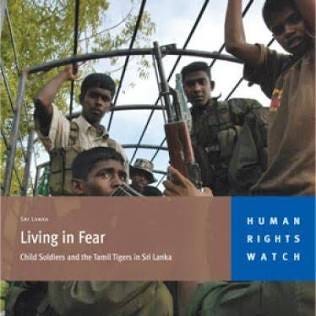
The Stolen Generation: Visual proof of the LTTE’s industrialized child recruitment.. Source: Human Rights Watch
The book reviews on amaruvi.in, particularly of Nirupama Subramanian’s Voices from a War Zone, recall the heartbreaking, ubiquitous sights of the Vanni: twelve- and thirteen-year-old children, wearing rubber chappals and carrying automatic rifles that were physically too large for their small frames, standing guard at checkpoints.
The LTTE systematically tore children away from their families, handed them cyanide capsules (kuppi), and brainwashed them into believing that their highest human purpose was to atomize themselves for the supreme leader. This was a massive generational theft. The LTTE did not build universities or design sustainable economies; they engineered a culture of necrophilia where death was the only celebrated achievement.
Furthermore, the LTTE’s vision for “Eelam” was deeply xenophobic and exclusionary. In October 1990, the LTTE executed one of the most underreported acts of ethnic cleansing in modern history. They issued a fascist edict giving the entire Muslim population of the Northern Province—over 75,000 people—exactly 48 hours to leave. Families who had lived there for generations were stripped of their jewelry, cash, and property, expelled with nothing but the clothes on their backs. This systematic “minority extermination” and forced expulsion proved that if the LTTE had ever achieved their state, it would have been an apartheid, fascist military junta.
3. The Ultimate Strategic Stupidity: The Sriperumbudur Massacre
No single act demonstrates the sheer, unadulterated strategic vacuum at the heart of the LTTE quite like the assassination of former Indian Prime Minister Rajiv Gandhi on May 21, 1991, in Sriperumbudur. It stands as an act of political suicide so profoundly shortsighted that it permanently sealed the fate of the insurgent movement.
Before the assassination, India was the LTTE’s most critical geopolitical asset. The state of Tamil Nadu provided a safe sanctuary, a logistical rear base, medical treatment for wounded cadres, and a highly sympathetic political audience. New Delhi was the only regional superpower with the geopolitical muscle to pressure Colombo into granting political devolution to the Tamil minority.
Prabhakaran’s decision to send Thenmozhi Rajaratnam (Dhanu) to blow up Rajiv Gandhi was an act of raw, petulant vengeance, entirely devoid of political foresight. As The Hindu has noted in its exhaustive retrospective analyses of the trial and investigation, this move boxed the LTTE into an inescapable corner.
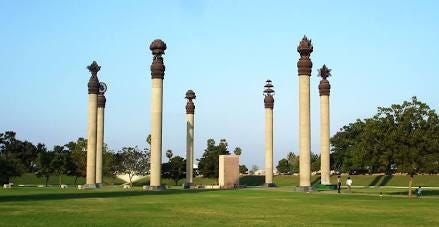
Sriperumbudur Memorial: The ground zero of the LTTE’s geopolitical suicide.. Source: Wikipedia
But when Dravidian politicians celebrate this act of terror, or when they soft-pedal the history of that horrific night, they conveniently erase the names of the local Tamils who were ripped apart alongside Gandhi.
Let us look at the names of the dead. Let us name the police officers and citizens who were slaughtered in that field:
Edward Joseph (Inspector of Police)
K.S. Mohammed Iqbal (Superintendent of Police)
T.K. Poddu (Sub-Inspector of Police)
Rajaguru (Sub-Inspector of Police)
S. Bethany (Police Constable)
G. Chidambaram (Police Constable)
Dharman (Police Constable)
Murugan (Police Constable)
Ravi (Police Constable)
Pradip Gupta (Personal Security Officer to Rajiv Gandhi)
Latha Kannan (Mahila Congress worker)
Kokilavani (Latha’s 15-year-old daughter, a young girl with her whole life ahead of her)
Santhani Begum (League worker)
Kavitha (Schoolgirl)
Samdhani
Murugesan
Babu
Look closely at those names. Edward Joseph, Iqbal, Poddu, Rajaguru, Chidambaram, Murugan, Latha Kannan, 15-year-old Kokilavani.
Were these men, women, and children not Tamil enough to merit the sympathy of M.K. Stalin or Joseph Vijay? Why do their lives matter less than the “grievances” of a convicted bomb-maker? When Dravidian leaders romanticize the perpetrators, they are effectively declaring that these local Tamil police officers—who went to work that day to protect a public event—were merely acceptable collateral damage in the service of a foreign warlord’s ego. It is a disgusting, unmitigated betrayal of local Tamil lives.
The immediate consequences of this massacre were catastrophic for the Tigers:
Complete Loss of Strategic Depth: In an instant, the LTTE alienated 1.3 billion people. India rightfully designated the LTTE as a terrorist organization, cracked down heavily on its logistics networks in Tamil Nadu, and closed the border.
Geopolitical Isolation: By assassinating a global leader on foreign soil, the LTTE signaled to the international community that it was not a legitimate liberation army, but a rogue transnational terrorist enterprise.
The Post-9/11 Realignment: The LTTE completely failed to read the shifting global paradigm. After the September 11 attacks, the world’s tolerance for non-state actors using systematic suicide terrorism plummeted to zero. While the Western world was freezing assets and banning the Tigers, Prabhakaran remained insulated in his underground bunkers in the Vanni, entirely blind to the global consensus aligning against him.
4. The Modern Chic: Prabhakaran as a Fashion Statement
In the current landscape of Tamil Nadu politics, showcasing Velupillai Prabhakaran has mutated into a bizarre, highly aestheticized brand of radical chic. What was once a covert, fringe sentiment has now been fully normalized, commercialized, and packaged for mass consumption.
Fringe outfits like Seeman’s Naam Tamilar Katchi (NTK) paved the way by turning Prabhakaran’s portrait into a religious icon, using his militaristic imagery to appeal to disillusioned, unemployed youth. They weaponize a hyper-masculine, ultra-nationalist fantasy world where complex geopolitical failures are reduced to aggressive rhetoric and battlefield aesthetics.
                  [THE ANATOMY OF MODERN DRIVIDIAN CHIC]
                                    │
         ┌──────────────────────────┴──────────────────────────┐
         ▼                                                     ▼
[The Political Utility]                               [The Visual Aesthetic]
 - Sub-nationalist posture to bully                    - Red-and-yellow tiger camo
   the Central Government.                             - Oversized posters of a warlord
 - Cheap "Tamil Pride" validation                      - Camouflage jackets worn by
   without economic accountability.                      wealthy urban film stars.
Today, this trend has broken out of the fringe and into the mainstream. Young urbanites, who have never spent a single night in a blacked-out bunker or heard the rattle of a multi-barrel rocket launcher, casually plaster tiger-stripe decals on their motorcycles. Mainstream Kollywood directors insert subtle, approving nods to the “Vanni warriors” in big-budget action films, and politicians treat the LTTE chief as a historical shortcut to prove their “Dravidian authenticity.”
This is the ultimate luxury belief: celebrating an ethno-fascist dictatorship from the absolute safety of a democratic republic. It is a shallow, performative pose that allows wealthy celebrities and comfortable politicians to flirt with radicalism without ever having to pay the price.
5. The Congress Party’s Moral Decay: Siding with the Sympathizers
Perhaps the most tragic irony of modern Indian politics is the current stance of the Indian National Congress. For a party whose top leader was blown to pieces by an LTTE suicide bomber, the modern shift toward soft-pedaling Tamil extremism for electoral gains is a profound betrayal of Rajiv Gandhi’s memory.
Under the contemporary leadership of Rahul Gandhi, the Congress has increasingly aligned itself with political forces in Tamil Nadu that are openly sympathetic to the LTTE’s legacy. By forming unholy electoral alliances with Dravidian fringe elements and hardline nationalist parties that openly lionize Prabhakaran, the Congress is signaling a chilling level of political opportunism.
Critics argue that Rahul Gandhi’s rhetoric of “constitutionalism” and “protection of national institutions” rings completely hollow when his party shares platforms with those who celebrate a warlord who shredded the very fabric of Indian security. This is a severe moral rot. By providing a mainstream political cloak for LTTE sympathizers in exchange for parliamentary seats, the Congress party has actively helped to rehabilitate a terrorist legacy that India spent decades trying to dismantle. It is a direct insult to the hundreds of Indian Peace Keeping Force (IPKF) soldiers who died fighting Tiger treachery in Sri Lanka, and a total surrender to the very forces that struck at the heart of Indian democracy.
6. The Lineage of Treason: From Karunanidhi’s Pandering to Vijay’s Farce
The historical rehabilitation of this dark history reached a peak of performative absurdity in May 2026. C. Joseph Vijay, the newly minted political actor and Chief Minister of Tamil Nadu heading the Tamilaga Vettri Kazhagam (TVK) government, chose the anniversary of the end of the Sri Lankan civil war to issue a public statement paying tribute to the legacy of Mullivaikkal and implicitly romanticizing the “struggle.”
This performance deserves absolute, unmitigated ridicule. For a mainstream film star turned politician to romanticize a warlord who pioneered the suicide vest and used his own people as human shields is the height of intellectual laziness and moral bankruptcy. Vijay’s attempt to brandish “Tamil pride” by invoking the name of a man who murdered Tamil intellectuals is a grotesque insult to the victims of the Vanni.
But Vijay is not an anomaly; he is simply the latest actor executing a well-worn, treacherous playbook. This performative salute to the LTTE directly inherits the dangerous legacy of M. Karunanidhi and the DMK. Throughout the late 1980s and leading up to the tragedy of 1991, Karunanidhi notoriously coddled and shielded the LTTE on Indian soil, turning a blind eye to their weapons smuggling, illegal wireless networks, and safe houses across Tamil Nadu. Even after the horrors perpetrated by the Tigers, Karunanidhi infamously played semantic games, refusing to explicitly brand Prabhakaran a terrorist and casually dismissing him as a “brother” caught in a hard struggle.
Let us call this what it is: veiled secessionism. Both Karunanidhi in the past and Vijay today have engaged in a highly dangerous game of playing to ultra-nationalist, sub-nationalist sentiments that undermine the sovereignty of the Indian Union. By saluting a group that fought an armed war for an ethnically pure separate state, these leaders hint at a toxic “Tamil First” identity that places linguistic chauvinism above national integrity.
They use the emotional trauma of the Sri Lankan Tamils as currency to fuel a radical, fringe narrative in domestic politics. It exposes the hollow, opportunistic nature of celebrity-driven politics in Tamil Nadu, where complex, bloody histories are reduced to slogans and posters to catch the eye of an emotional electorate. Figures like Vijay are not interested in the nuances of geopolitical stability; they are interested in the optics of the “warrior king,” ignoring the fact that this “king” led his people directly into a slaughterhouse.
7. The State-Enforced Insult: Stalin’s Embrace and the Perarivalan Travesty
If the performative sycophancy of actors and the historical amnesia of political parties were not enough, the institutional, state-sponsored gaslighting of the Indian public reached an all-time low under then Chief Minister M.K. Stalin.
Following the Supreme Court’s 2022 order releasing A.G. Perarivalan—a man found guilty and convicted for his indispensable role in providing the bomb components that liquidated a former Prime Minister and 15 innocent bystanders—Stalin went so far as to personally meet and warmly embrace the freed convict at the airport.
The optics were sickening. A sitting Chief Minister, bound by an oath of office under the Indian Constitution, rolled out the red carpet for a terrorist conspirator as if he were a returning Olympic champion or a freedom fighter. The state machinery was twisted to portray a hardened accomplice to a foreign-directed assassination as a victimized cultural icon. By erasing the term “convict” and actively celebrating his release, Stalin and the DMK effectively spat on the graves of the Indian security personnel and citizens who were blown to pieces in that Sriperumbudur field.
The madness, however, did not stop at cheap political theatre. It metastasized directly into the hallowed halls of institutional justice. In April 2026, the Bar Council of Tamil Nadu and Puducherry officially enroled A.G. Perarivalan as a practicing advocate, allowing him to don the black robes of the court and walk into the Madras High Court as an officer of the law.
The rationale offered by the Bar Council’s enrolment committee was a masterclass in bureaucratic cowardice. They cited Section 24A of the Advocates Act of 1961, lamely pointing out that the statutory disqualification for a convict involving “moral turpitude” conveniently expires exactly two years after their release from prison.
This is nothing short of an absolute travesty and a black day for the Indian judiciary. The legal system has engineered a reality where an individual convicted of plotting the assassination of the head of state can, after a brief “cooling-off” period, be granted the profound privilege of arguing the law, accessing sensitive judicial records, and operating within the state’s justice-delivery mechanism.
The apex court, by excessively misusing its extraordinary powers under Article 142 to release these individuals under the guise of “delayed executive processing,” has actively triggered a domino effect of moral decay. When the highest court in the land treats the accomplices of an ethno-fascist terror apparatus with kid gloves, it signals to local Bar Councils and regional chauvinists that acts against the state are open to negotiation, rehabilitation, and ultimate celebration.
8. The Final Cowardice at Mullivaikkal
The end of the LTTE in May 2009 was not a heroic, Thermopylae-style last stand. It was a cowardly, logistical disaster that exposed the leadership’s utter disregard for human life. As the Sri Lankan armed forces closed in on the last remaining stronghold, the LTTE did not step out to face the army in isolated combat. Instead, they packed nearly 300,000 Tamil civilians into a narrow, suffocating strip of coastal land in Mullivaikkal, deliberately transforming their own people into a massive, human shield.
Reports from the United Nations, independent journalists, and extensive analyses reviewed on amaruvi.in confirm a horrifying reality: the Tigers systematically positioned their heavy artillery directly inside makeshift civilian hospitals and densely populated “No Fire Zones,” intentionally drawing government shelling onto their own citizens to generate international outrage and force a foreign intervention.
Worse still, when desperate, starving Tamil civilians attempted to flee across the lagoon to safety in government-controlled areas, LTTE cadres turned their weapons around and shot their own people in the back. Prabhakaran’s refusal to surrender cannot be considered as an act of bravery; it was a messianic delusion that required the sacrifice of thousands of innocent lives to sustain his bloated ego. The LTTE ended not as a proud liberation army, but as a cornered death cult that murdered its own people in a desperate, failed bid for personal survival.
9. Conclusion: The Imperial Necessity of Historical Truth
The LTTE was an absolute catastrophe for the Tamil people. They took a legitimate struggle against systemic discrimination and turned it into a thirty-year humanitarian nightmare. To fiercely critique the LTTE is not to support the heavy-handed excesses or war crimes of the Sri Lankan state, but to recognize that the Tigers were a fascist, totalitarian obstacle to any real, lasting peace.
As we look at the Indian political landscape today, the attempt to sanitize and rehabilitate Velupillai Prabhakaran must be aggressively rejected. Whether it is the cheap, performative opportunism of Actor Vijay, the historical, spineless betrayal of the Congress party under Rahul Gandhi, or the grotesque state-sponsored hero-worship of convicts by M.K. Stalin, catering to terrorist sympathizers is an affront to history.
When our courts and bar councils allow the architects of national tragedies to wear the robes of justice, they erode the very foundational legitimacy of the republic. True justice and a viable political future for the Tamils of Sri Lanka will only come when they are finally free from the shadow of the Tiger—a shadow that has always brought ruin, blood, and absolute darkness.
Sources and Primary Documentation
The core insights, book reviews, and historical critiques utilized in this article are drawn directly from the documented analyses on the blog Amaruvi’s Aphorisms:
The Prabhakaran Saga – a review: https://amaruvi.in/2015/12/18/the-prabhakaran-saga-a-review/
An in-depth review of S. Murari’s work detailing the internecine warfare among Tamil militant groups and the strategic blindness of the LTTE post-9/11.
This Divided Island – a review: https://amaruvi.in/2015/12/12/this-divided-island-a-review/
An examination of Samanth Subramanian’s book, documenting the deep social scars, structural ruin, and internal devastation left behind by the conflict.
Sri Lanka – Voices from a War Zone – Book review: https://amaruvi.in/2025/04/13/sri-lanka-voices-from-a-war-zone-book-review/
A critical review of Nirupama Subramanian’s journalistic accounts, detailing the horrors of child soldier recruitment, the forced expulsion of Muslims, and the breaking of ceasefires.
A fleeting moment in my country – a review: https://amaruvi.in/2015/12/16/a-fleeting-moment-in-my-country-a-review/
An analysis of N. Malathy’s perspective, highlighting the claustrophobic reality of civilians living under the absolute control of the LTTE administration.
Triumph of Truth – book review: https://amaruvi.in/2016/01/17/triumph-of-truth-book-review/
An analysis of D.R. Karthikeyan’s chronology regarding the investigation into the assassination of Rajiv Gandhi and the unraveling of the core conspiracy.
Additional Critical Documentation & Verifiable Links
Human Rights Watch (HRW): Living in Fear: Child Soldiers and the LTTE
The definitive international investigative dossier proving the systematic, institutionalized state of child recruitment and deployment by the Vanni leadership.
University Teachers for Human Rights (UTHR-J): Special Report No. 3 - The Broken Palmyra
The historical milestone documentation compiled by local Tamil academics in Jaffna, tracing how the LTTE systematically liquidated its internal critics, leading directly to the assassination of Rajani Thiranagama.
The Indian Judiciary Archives: Supreme Court Judgment on Rajiv Gandhi Assassination - State Of Tamil Nadu vs Nalini
The absolute legal record detailing the forensic, wireless, and physical evidence connecting the core LTTE conspirators to the Sriperumbudur blast.
United Nations Inquiries: Report of the Secretary-General’s Panel of Experts on Accountability in Sri Lanka (2011)
The formal UN evaluation establishing the systematic use of human shields and the summary execution of fleeing Tamil civilians by the LTTE command structure at Mullivaikkal.
NDTV Report on Chief Minister Joseph Vijay’s Tribute Controversy
I'm heartbroken that you did not mention the late MGR. Oh. Sorry! It's bad manners to speak ill of those who have passed on.
https://www.tamilguardian.com/content/mgrs-109th-birth-anniversary-commemorated-jaffna
Sir, thank you for writing in such detail about Prabhakaran and the LTTE. How can the intelligentsia and the opinion makers of a state (Tamil Nadu) just completely ignore the actual history of this terrorist organization? I am just amazed at this process of myth making, where monsters are magically transformed into demigods. Constant reminders of the truth are the only antidote for this disease. Please keep writing like this again and again. Thank you!